





IHBC warn government on retrofitting older homes

In November 2017, the Institute of Historic Building Conservation (IHBC), along with several leading heritage organisations and client bodies, wrote to the government to highlight the way ‘flawed’ energy efficiency policy is leading to mis-treatments in traditional buildings.
Advised and led for the IHBC by ‘Green’ Panel Chair John Preston, the IHBC has joined together with other bodies - including the Church of England and the National Trust - to write to the Government to explain that the one-size-fits-all approach to energy efficiency fails to recognise the unique nature of heritage properties.
John Preston said:
"This collective letter and release is from a group of heritage bodies with a critical mass which should make Government sit up and take notice. Anything others can do to spread the word will only help.
"This initiative complements the technical evidence gathered by IHBC, SPAB, HE, HES, STBA and NT, and takes the issues raised to a much higher public and political level. This is a crucial step in arguing for radical changes to Government approaches to retrofit specifically, and to counter the damaging impacts of deregulation in terms of both unavailability of advice, and the damage and waste arising from uncoordinated and inappropriate measures.
"Pending a response from Ministers to the letter, a further crucial test will be the (delayed) publication of the Government’s response to December 2016’s consultation on SAP and RdSAP, on which EPCs and the whole basis of the Government’s approach to retrofit depend. This response may be published by 20 November if it is not delayed again. Watch this space!"
IHBC Chair – and co-signatory of the letter – James Caird said:
"We share the Government’s concern on climate change and agree that energy efficiency is central to tackling it but there are substantial flaws in the policy which left unaddressed have the potential to damage homes, cause disruption in the property market and fail to achieve the Government’s energy efficiency objectives.
"Older buildings are an important part of our national heritage and are highly sought after for their character. It would be a tragedy for the Government to put them at risk with an overly simplistic approach to energy efficiency.
"Together we want to encourage better investment in housing to achieve warmer, more efficient homes, but this is undermined when property owners do not have faith in the information found in energy performance certificates."
Signatories are:
- National Trust.
- Church of England.
- Sustainable Traditional Buildings Alliance (STBA).
- Society for Protection of Ancient Buildings (SPAB).
- Historic Houses Association (HHA).
- Institute of Historic Building Conservation (IHBC).
- Joint Committee of the National Amenity Societies (JCNAS).
- Country Land and Business Association (CLA).
This article was originally published here by IHBC on 10th Nov 2017.
--Institute of Historic Building Conservation
[edit] Find out more
[edit] Related articles on Designing Buildings Wiki
IHBC NewsBlog
IHBC sponsors Gardens Trust event 23-4 Sept 2026
.jpeg)
'Learning from the Past, Shaping the Future’ takes place in Milton Keynes
Renovations to Frank Lloyd Wright's Fallingwater complete
.jpg)
World Heritage Preserved project opens house for tours again
Shakespeare Birthplace Trust places Hall's Croft on HAR Register
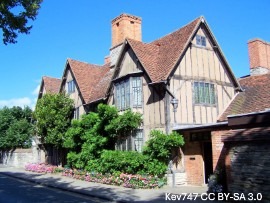
Stratford-upon-Avon home of Shakespeare's daughter is 'At Risk'
Lady Grange’s House repaired on St Kilda
.jpg)
National Trust for Scotland repairs stone cleit with link to famous island resident
Griff Rhys Jones on BBC Radio 4 Today programme
,_Green_Lane,_Derby.jpg)
The Victorian Society’s President unveiled its latest Top Ten Endangered Buildings 2026.
Need a MATE? Book your place now.

IHBC offers free webinars on applying for IHBC accreditation (Full & Associate).
UK Stained Glass Repository finds windows new homes
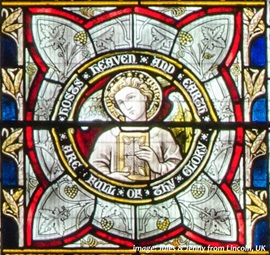
How are stained glass windows are rescued, stored and repurposed?
APPGEBE report sets high aims for quality
'Government must not sacrifice quality in drive to build 1.5m homes'
New measures protect Historic Shipwrecks from heritage crime

Underwater cultural heritage benefits from new HE guidance
How could the City of London skyline look in 6 years' time?

Visualisation shows approved planning applications as completed buildings
National Trust for Scotland calls for VAT cuts
Heritage neglect is encouraged by current policies
IHBC's 'Context' Issue 186 features Industrial Heritage
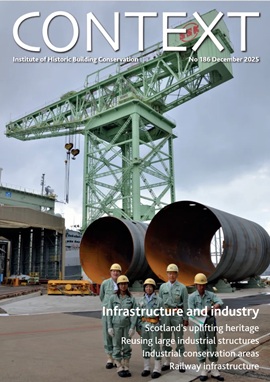
IHBC's members' journal reports on the challenges of conserving infrastructure
Book now for IHBC Annual School 2026
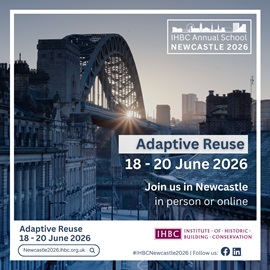
IHBC Annual School is taking place 18-20 June 2026 in Newcastle
RICHeS Research Infrastructure offers ‘Full Access Fund Call’

RICHeS offers a ‘Help’ webinar on 11 March
Latest IHBC Issue of Context features Roofing
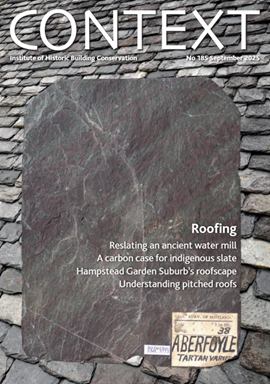
Articles range from slate to pitched roofs, and carbon impact to solar generation to roofscapes
Three reasons not to demolish Edinburgh’s Argyle House

Should 'Edinburgh's ugliest building' be saved?
IHBC’s 2025 Parliamentary Briefing...from Crafts in Crisis to Rubbish Retrofit
IHBC launches research-led ‘5 Commitments to Help Heritage Skills in Conservation’
How RDSAP 10.2 impacts EPC assessments in traditional buildings

Energy performance certificates (EPCs) tell us how energy efficient our buildings are, but the way these certificates are generated has changed.